Why Drone Farming Is Taking Off in Vietnam?
Vietnamese agriculture is entering a new stage. For decades, productivity came mainly from hard work, land expansion, irrigation, fertilizers, pesticides, and farmer experience. But the next wave of competitiveness will come from precision, traceability, lower input waste, climate adaptation, and smarter farm management.
Agricultural drones are one of the clearest examples of this shift.
In Vietnam, drones are now being used for pesticide spraying, fertilizer application, seed spreading, crop monitoring, orchard management, and field mapping. What used to require teams of workers walking through muddy rice fields or climbing through orchards can now be done from the air in a fraction of the time.
Vietnam News reported in 2026 that agricultural drones have moved rapidly “from novelty to necessity” across rice paddies, fruit orchards, and coffee plantations, compressing jobs that once took days into hours. The same report noted that drone spraying can use up to 70% less water and 50% less pesticide than conventional methods while maintaining equal or better pest control.
For Vietnam, this is not just a technology trend. It is a response to real agricultural pressure: labor shortages, rising input costs, climate stress, export quality requirements, and the need to produce more with less.
What Is Drone Farming?
Drone farming means using unmanned aerial vehicles, or UAVs, to support agricultural production. In Vietnam, the most common type is the spraying drone, used to apply pesticides, foliar fertilizers, biological products, or nutrients over rice fields and orchards.
But drone farming is broader than spraying. A complete drone farming system may include:
- Spraying drones for pesticides, nutrients, bio-products, and disease control.
- Spreading drones for seeds, fertilizer granules, or cover-crop seeds.
- Mapping drones for field surveys and digital farm maps.
- Multispectral drones for crop health monitoring, NDVI analysis, and stress detection.
- Service drones operated by cooperatives, contractors, or rural entrepreneurs for many small farmers.
Globally, drones are considered part of precision agriculture because they allow farmers to collect high-resolution field data and apply inputs more accurately. A 2023 review of agricultural drone applications highlighted key advantages such as improved data collection, precision spraying, cost and time savings, better crop management, improved access to difficult terrain, and reduced exposure of workers to chemicals.
In Vietnam, the first mass-market use case is not futuristic crop analytics. It is much more practical: spraying and spreading faster, safer, and with less waste.
Why Vietnam Is a Good Market for Agricultural Drones
Vietnam is especially suitable for agricultural drone adoption for five reasons.
First, Vietnam has large areas of rice, fruit, coffee, pepper, cashew, tea, vegetables, and aquaculture-linked farming systems. Many of these crops require repeated spraying or fertilization during the season.
Second, labor is becoming more expensive and harder to find in many rural areas. Younger workers are moving to cities or industrial zones, while older farmers still carry out physically demanding tasks.
Third, many farms are small and fragmented. This may seem like a disadvantage, but service-based drone operators can solve the problem by serving many small plots in the same commune or district.
Fourth, Vietnam’s export agriculture is under pressure to reduce residues, improve traceability, and standardize quality. Drone spraying cannot solve these issues alone, but it can help make application more consistent and recordable.
Fifth, climate change is making farm timing more important. In rice, fruit, and vegetables, a pest or disease outbreak can spread quickly. A drone team can cover an area faster than manual spraying, which matters when treatment windows are short.
The Mekong Delta shows why this matters. AP reported that the Delta produces around 90% of Vietnam’s exported rice, while also being one of the regions most vulnerable to climate change. Vietnam is also targeting 1 million hectares of high-quality, low-emission rice cultivation by 2030, with techniques such as alternate wetting and drying, straw management, and more precise input application. Drones are already appearing in this climate-smart rice transition, including fertilizer application.
How Much Does Drone Farming Cost in Vietnam?
The cost depends on whether a farmer buys a drone or hires a drone spraying service.
1. Buying an agricultural drone
For individual farmers, buying a drone is only suitable when there is enough land, enough service demand nearby, or a plan to operate as a local spraying business.
In Vietnam, published drone prices vary widely depending on model, payload, battery package, warranty, accessories, and after-sales support.
Vietnam News reported in late 2024 that many agricultural drones in the Mekong Delta were priced around VNĐ300 million each. Some newer dealer listings show lower entry prices for specific models; for example, AgriDrone Vietnam listed the DJI Agras T50 at VNĐ191 million in Vietnam, though package configuration and after-sales terms can change by dealer and timing.
A realistic purchase budget for a professional agricultural drone operation in Vietnam should include:
| Cost item | Estimated range |
|---|---|
| Agricultural drone | VNĐ190–500 million |
| Extra batteries and charger | VNĐ30–120 million |
| Training and certification support | VNĐ5–30 million |
| Spare parts and maintenance reserve | VNĐ20–80 million/year |
| Transport setup | VNĐ10–80 million |
| Protective gear, mixing tools, field accessories | VNĐ5–30 million |
| Working capital | VNĐ20–100 million |
For most small farmers, buying a drone is not the best first step. Hiring a drone service is usually more practical.
2. Hiring a drone spraying service
Drone spraying services are already active in the Mekong Delta. Tuoi Tre News reported that drone service fees in one case fell from around VNĐ180,000 per hectare to VNĐ120,000 per hectare as more operators entered the market. Other Vietnamese industry estimates commonly quote around VNĐ140,000–160,000 per hectare for rice-field spraying services, with professional teams using larger drones able to spray 30–50 hectares per day in favorable conditions.
For a farmer, this means drone spraying is often a variable cost rather than a large capital investment.
Example:
If a rice farmer hires a drone service at VNĐ150,000 per hectare and sprays 5 times per crop season, the drone service cost is:
VNĐ150,000 × 5 = VNĐ750,000 per hectare per crop
That cost must be compared with manual labor cost, speed, chemical efficiency, water use, disease-control timing, and reduced health exposure.
3. Service business economics
For rural entrepreneurs, cooperatives, and agricultural service providers, drones can become a profitable local service business.
Vietnam News reported a Mekong Delta case where a drone operation needed two operators and could generate approximately VNĐ90 million in monthly income, with potential profit of around VNĐ60 million per month after expenses in the reported case.
However, these numbers should not be treated as guaranteed profit. Real results depend on:
- Local competition.
- Crop density in the service area.
- Number of spraying days per month.
- Weather conditions.
- Battery management.
- Machine downtime.
- Operator skill.
- Customer trust.
- Seasonality.
- Pricing pressure.
The best business model is not simply “buy a drone and wait for customers.” The stronger model is:
drone + trained pilot + local farmer network + agronomy knowledge + scheduling system + maintenance discipline.
Benefits of Drone Farming in Vietnam
1. Faster field operations
Speed is the first and most visible benefit.
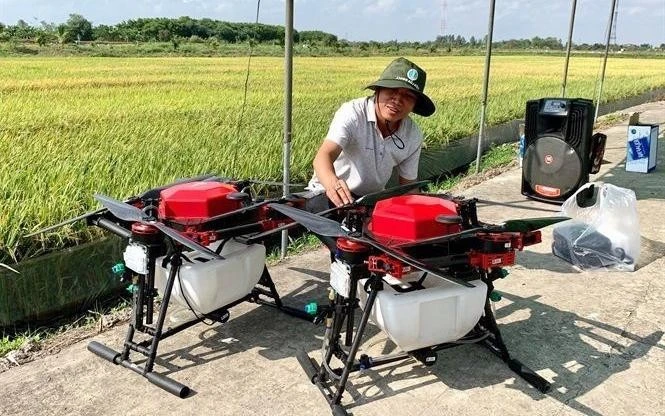
A VietnamPlus report on Hanoi’s agricultural drone program said a drone could spread seeds over 4 hectares in one hour and spray pesticide over 40 hectares per day in good weather conditions.
This speed matters because crop protection is often time-sensitive. If pest pressure rises after rain or disease appears during humid weather, delayed spraying can reduce effectiveness. A drone service team can cover many small plots in a short treatment window.
2. Lower labor dependence
Manual spraying is physically demanding, especially in rice fields, hilly farms, and orchards. Workers may need to carry heavy tanks, walk through mud, climb slopes, or enter areas with high pest pressure.
Drone spraying reduces the need for people to walk directly through treated fields. It does not eliminate labor, but it changes the work from heavy manual spraying to skilled operation, battery handling, mixing support, and field supervision.
This is especially valuable in areas where rural labor is aging or seasonal workers are difficult to hire.
3. Reduced exposure to chemicals
One of the strongest arguments for drones is worker safety. Manual pesticide spraying can expose farmers to chemical drift, skin contact, inhalation, and heat stress. Drones allow operators to stand farther away from the spray path and reduce direct exposure.
This benefit is not automatic. Operators still need proper training, protective equipment, safe mixing practices, and responsible pesticide management. But compared with backpack spraying, drone spraying can reduce the most dangerous part of the job: walking through the field while applying chemicals.
4. Less water and more precise application
Drone spraying uses low-volume application. Instead of carrying large amounts of water across the field, drones apply smaller, more targeted volumes.
Vietnam News reported that drone spraying can use up to 70% less water and 50% less pesticide than conventional methods while achieving equal or better pest control.
This is highly relevant for the Mekong Delta, Central Highlands, and drought-prone regions where water efficiency is becoming more important.
5. Better access to difficult terrain
Drones are useful in places where manual or tractor-based operations are difficult:
- Wet rice fields.
- Hilly coffee farms.
- Fruit orchards with narrow rows.
- Areas after rain.
- Fragmented plots.
- Fields with poor road access.
- Farms where machinery would damage soil or crops.
This makes drones useful not only for large farms, but also for small farms grouped into cooperative service zones.
6. Better standardization for export crops
Export agriculture requires consistency. Buyers increasingly care about pesticide residue, traceability, harvest timing, and quality control.
Drones can support this by making spraying more uniform and easier to document. In the future, drone service records could become part of a traceability package: date, location, crop, product used, dosage, operator, weather, and field map.
For export-oriented products such as durian, mango, dragon fruit, coffee, pepper, rice, and vegetables, this record-keeping function may become as valuable as the spraying itself.
Main Use Cases of Drone Farming in Vietnam
Use Case 1: Rice farming in the Mekong Delta
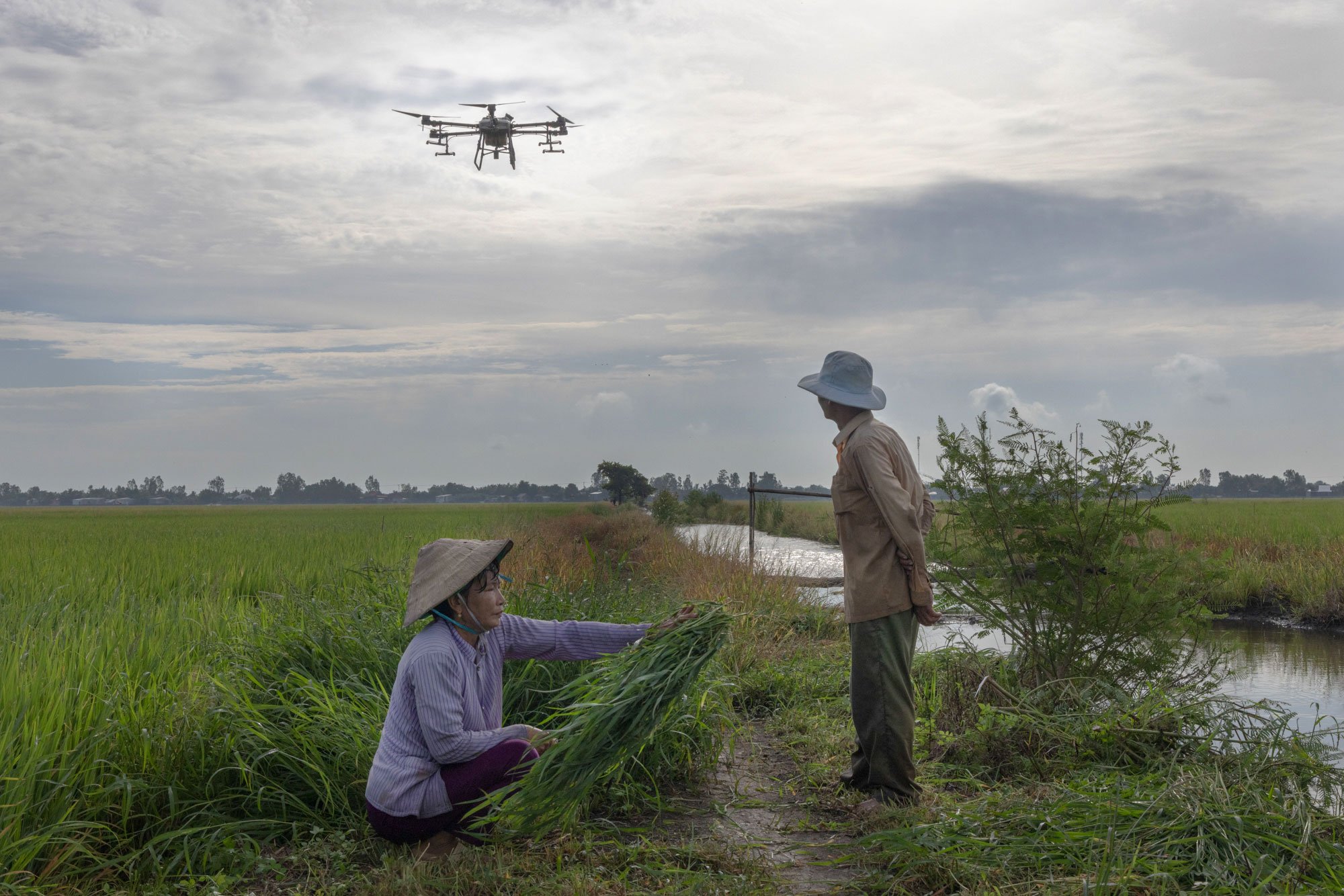
Rice is the clearest use case because fields are relatively open, spraying demand is repeated, and service providers can cover many farmers in one area.
Drones can be used for:
- Pesticide spraying.
- Foliar fertilizer application.
- Seed spreading.
- Granular fertilizer spreading.
- Monitoring crop stress.
- Supporting low-emission rice programs.
The low-emission rice transition makes this use case especially important. Vietnam’s 1-million-hectare high-quality, low-emission rice program will require better water management, straw management, input efficiency, and standardized field practices. Drones fit naturally into this system when combined with agronomy advice and field records.
Use Case 2: Durian orchards
Durian has become one of Vietnam’s most important high-value fruit exports. In orchards, drones can help with foliar feeding, pest control, and disease prevention, especially where labor is expensive or trees are difficult to treat evenly.
Drone adoption in durian is attractive because the crop value is high. Even a small improvement in disease control, timing, or labor efficiency can justify service costs.
However, orchards are more complex than rice fields. Tree height, canopy density, wind, row spacing, and spray penetration matter. Drone operators need orchard-specific experience, not just rice-field experience.
Use Case 3: Coffee farms in the Central Highlands
Coffee farms in Dak Lak, Lam Dong, Gia Lai, and other Central Highlands provinces can benefit from drones for crop monitoring, targeted spraying, and terrain access.
Drones are useful where slopes, uneven terrain, or labor shortages make manual operations difficult. They may also support farm mapping and yield zone analysis in larger coffee farms.
For specialty coffee and export-oriented coffee, drones could eventually support sustainability documentation and better input management.
Use Case 4: Vegetables and high-value horticulture
Vegetable farms need precise timing because pest and disease cycles can move quickly. Drones can support rapid application over larger vegetable areas, especially in organized production zones.
The challenge is that vegetables are sensitive crops. Operators need to avoid over-application, drift, and improper timing. For vegetables, drones should be used with careful agronomy supervision and residue-management discipline.
Use Case 5: Seed spreading and cover crops
Drones are not only for spraying. They can spread seeds and granular materials.
In Hanoi’s agricultural drone program, VietnamPlus reported that a drone could spread seeds over 4 hectares per hour.
This is useful for:
- Rice seeding.
- Cover crops.
- Green manure crops.
- Grass or forage establishment.
- Replanting difficult areas.
- Post-harvest field preparation.
As Vietnam moves toward regenerative and low-emission agriculture, seed-spreading drones may become more important.
Use Case 6: Farm mapping and crop monitoring
Spraying drones are the current mainstream, but mapping drones may become more valuable over time.
A mapping drone can help farmers and agribusinesses:
- Create farm boundary maps.
- Identify weak growth zones.
- Check irrigation problems.
- Detect pest or disease stress early.
- Compare crop performance across fields.
- Support insurance or credit assessment.
- Build traceability records.
Vietnamese research has also explored combining drones with wireless sensor networks. One study developed a system using LoRa wireless sensors and UAVs for agricultural inspection, collecting weather, soil, and plant-health data to support decisions on irrigation, pest treatment, and fertilization.
This points to the future: drones will not be standalone machines. They will become part of a farm data system.
Challenges and Risks
1. Regulation and flight permission
Drone operation in Vietnam is regulated. Farmers, cooperatives, and drone service providers should not assume they can fly anywhere without permission.
Vietnam News reported that no-fly and restricted zones for drones were announced in June 2025, and that flight permits for UAVs and other aerial vehicles can be applied for online via the Ministry of National Defence’s Public Service Portal.
Before operating commercially, drone users should check current rules, local restrictions, and required permissions.
2. Operator skill matters
A drone is not a magic machine. Poor operation can waste chemicals, miss target areas, cause drift, damage crops, or create safety risks.
Good operators need to understand:
- Flight planning.
- Spray width.
- Droplet size.
- Wind conditions.
- Crop height.
- Battery planning.
- Safe takeoff and landing.
- Field obstacles.
- Emergency procedures.
- Basic agronomy.
For Vietnam, training may become the biggest bottleneck. The country does not only need more drones. It needs more professional agricultural drone operators.
3. Small and fragmented land plots
Vietnamese farms are often small and scattered. This can reduce drone efficiency if the operator must move constantly between small plots.
The solution is cooperative scheduling. Instead of one farmer hiring a drone alone, a group of farmers in the same area should coordinate spraying days. This reduces travel time and improves economics for the operator.
4. Maintenance and downtime
Agricultural drones work in harsh conditions: heat, humidity, dust, chemical exposure, mud, and repeated battery cycles.
Operators must budget for:
- Propellers.
- Pumps.
- Nozzles.
- Batteries.
- Motors.
- Sensors.
- Cleaning.
- Calibration.
- Software updates.
- Repair downtime.
A cheap drone with weak support can become expensive if it breaks during peak spraying season.
5. Not all crops are equally suitable
Drones work best when the field structure matches the technology. Rice, open fields, young orchards, and organized crop zones are easier. Dense orchards, tall trees, mixed gardens, and windy areas require more skill.
For some crops, drones should complement—not replace—manual inspection. A drone can spray, but a farmer still needs to walk the field, check leaves, inspect pests, and understand disease pressure.
Should Farmers Buy or Rent Drone Services?
For most small farmers, the answer is simple: rent first.
Buying a drone makes sense when one of these conditions is true:
- You own or manage a large farming area.
- You are a cooperative serving many members.
- You are building a local spraying service business.
- You have trained operators.
- You can maintain the machine properly.
- You have enough customers within a close service radius.
Hiring a drone service is better when:
- Your farm is small.
- You only need spraying a few times per season.
- You do not want maintenance responsibility.
- You are testing whether drone spraying works for your crop.
- You do not have trained staff.
- You want predictable per-hectare costs.
A good adoption path is:
Season 1: Hire a drone service on a small area.
Season 2: Compare cost, pest control, labor savings, and crop response.
Season 3: Coordinate with neighbors or a cooperative.
Season 4: Consider buying only if service demand is stable.
The Best Business Model: Drone-as-a-Service
Vietnam’s most realistic model is not one drone per farmer. It is Drone-as-a-Service.
In this model, a trained team owns and operates drones for many farmers. Farmers pay per hectare or per job. The operator handles equipment, maintenance, flight planning, and scheduling.
This model fits Vietnam because many farmers are smallholders. They need access to technology, but not necessarily ownership of technology.
The most promising operators will not be just “drone pilots.” They will become agricultural service partners offering:
- Spraying.
- Fertilizer spreading.
- Crop monitoring.
- Field records.
- Pest alerts.
- Input planning.
- Seasonal packages.
- Export-zone documentation.
Over time, the winning drone operators may look more like local agri-tech service companies than simple machine owners.
Practical ROI Example
Assume a drone operator buys a professional setup for VNĐ300 million and charges VNĐ150,000 per hectare.
If the team sprays 800 hectares per month during peak season:
Revenue = 800 × VNĐ150,000 = VNĐ120 million/month
Now subtract:
- Operator wages.
- Assistant wages.
- Batteries and charging.
- Transport.
- Maintenance.
- Depreciation.
- Marketing.
- Downtime.
- Permit/admin costs.
- Insurance or accident reserve.
Even if net margin is only 30–50%, the business can be attractive during peak months. But seasonality is the key risk. The operator must build enough customer density across different crops and seasons to keep the machine working.
A stronger annual model combines:
- Rice spraying in the Mekong Delta.
- Orchard spraying during fruit seasons.
- Fertilizer spreading.
- Seed spreading.
- Farm mapping.
- Cooperative contracts.
- Export production-zone service packages.
How Drone Farming Can Support Green Agriculture
Drone farming is not automatically green. A drone can still apply too much pesticide if the agronomy is poor. But when used correctly, drones can support greener agriculture in several ways.
First, drones can reduce water used in spraying. This matters in drought-prone and salinity-affected areas.
Second, drones can reduce chemical waste through more targeted application.
Third, drones can reduce farmer exposure to pesticides.
Fourth, drones can help with biological products and foliar nutrition, not only conventional chemicals.
Fifth, drones can support low-emission rice systems by applying inputs more precisely and helping farmers coordinate field operations.
Sixth, mapping drones can help detect problem zones earlier, allowing farmers to treat only where needed in the future.
The long-term direction is not simply “spray faster.” The real goal is:
less waste, better timing, better records, safer workers, and more profitable farms.
Recommended Adoption Strategy for Vietnam
For farmers:
Start by hiring a reliable local drone service. Test it on a limited area and compare the results with manual spraying. Track cost, crop response, pest control, labor savings, and timing.
For cooperatives:
Create a shared drone service unit. Train two to four operators. Build a seasonal spraying calendar. Use digital records for each member’s field. This is likely one of the best models for rice, fruit, and vegetable zones.
For rural entrepreneurs:
Do not compete only on price. Build trust, reliability, agronomy knowledge, and maintenance discipline. The operators who win long-term will be the ones who show up on time, spray correctly, keep records, and help farmers solve real problems.
For exporters and sourcing companies:
Use drones as part of a larger traceability and quality-control system. Do not treat drones as a gimmick. Connect drone records to farm codes, pesticide logs, harvest planning, and residue-control programs.
For policymakers:
Support training, safety standards, flight-permit clarity, cooperative access, and local service centers. Subsidizing machines without building operator capacity will not be enough.
Future of Drone Farming in Vietnam
The first stage of drone farming in Vietnam is about spraying. The second stage will be about service networks. The third stage will be about data.
In the future, a professional farm drone system may include:
- Field boundary maps.
- Crop health images.
- AI pest detection.
- Weather-linked spraying recommendations.
- Input application records.
- QR-code traceability.
- Carbon and sustainability reporting.
- Integration with irrigation sensors.
- Cooperative dashboards.
This is where Vietnam has a major opportunity. The country can leap from manual spraying directly into precision, traceable, climate-smart agriculture.
But the future will not be won by technology alone. It will be won by farmers, cooperatives, agronomists, local entrepreneurs, and exporters who know how to turn drones into practical farm value.
Conclusion
Drone farming in Vietnam is no longer a futuristic idea. It is already being used in rice fields, orchards, and high-value crop zones.
The benefits are clear: faster operations, lower labor dependence, reduced chemical exposure, lower water use, more precise input application, and stronger potential for export-oriented traceability.
The costs are also real. Buying a drone can require hundreds of millions of Vietnamese dong, plus batteries, training, maintenance, and working capital. For most small farmers, hiring a drone service is the better first step.
The biggest opportunity is not simply selling more drones. It is building a new layer of rural agricultural services: trained drone operators, cooperative scheduling, field records, smart input application, and climate-resilient production systems.
For Vietnam, drones are not just flying machines. Used correctly, they can become a bridge between traditional farming and the next generation of smart, green, export-ready agriculture.
FAQ
Are agricultural drones legal in Vietnam?
Yes, drones can be used in Vietnam, but operations are regulated. Users should check no-fly zones, restricted zones, and flight-permit requirements before operating. Vietnam announced public information on no-fly and restricted zones for drones in 2025, and flight permits can be applied for through the Ministry of National Defence’s Public Service Portal.
How much does it cost to spray one hectare by drone in Vietnam?
Common reported service fees are roughly VNĐ120,000–180,000 per hectare, depending on location, crop, season, competition, and service quality. Tuoi Tre News reported a Mekong Delta case where fees fell from VNĐ180,000 to VNĐ120,000 per hectare as competition increased.
Should small farmers buy a drone?
Usually no. Most small farmers should hire a drone service first. Buying makes more sense for cooperatives, large farms, or entrepreneurs who plan to provide services to many farmers.
Which crops are best for drone farming in Vietnam?
The strongest use cases are rice, durian, mango, dragon fruit, coffee, pepper, vegetables, and organized high-value crop zones. Rice is currently the easiest large-scale use case because fields are open and spraying demand is repeated.
Can drones reduce pesticide use?
They can, when used correctly. Vietnam News reported that drone spraying can use up to 50% less pesticide and up to 70% less water than conventional methods while maintaining equal or better pest control.
What is the biggest risk of drone farming?
The biggest risks are poor operator training, unclear compliance, bad maintenance, spray drift, over-competition among service providers, and treating drones as a shortcut instead of part of a proper agronomy system.
What is the best drone farming business model in Vietnam?
The best model is likely Drone-as-a-Service through cooperatives, local entrepreneurs, or agri-service companies. This allows small farmers to access drone technology without buying and maintaining expensive equipment themselves.
Originally posted 2026-07-08 08:42:22.